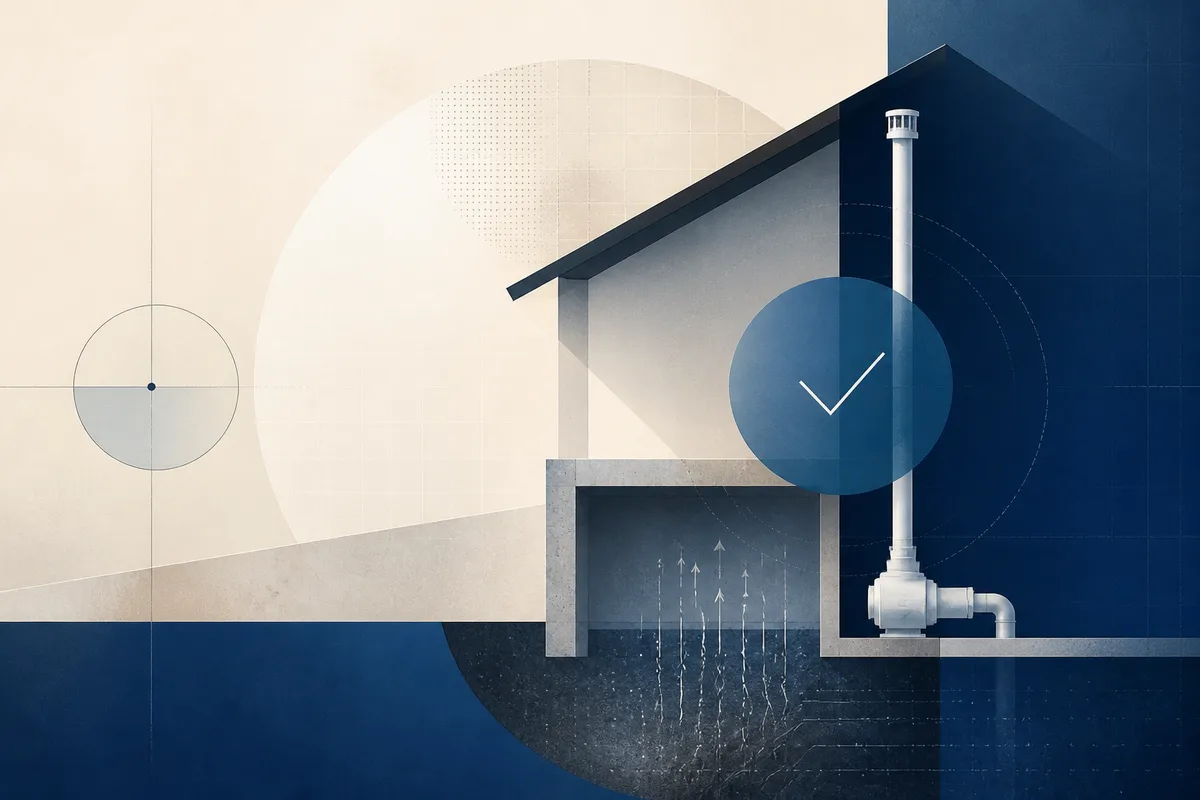
Why a Radon Mitigation System Requires Independent Validation
Installing a radon fan does not automatically guarantee a safe breathing zone. Many property owners treat mitigation as a "set and forget" utility, yet the physics of soil gas intrusion are dynamic, influenced by the stack effect and changing geological conditions. Relying solely on a manometer—the U-tube showing fan pressure—only confirms the motor is running, not that it is successfully capturing gas across the entire building footprint.
This guide outlines the operational requirements for verifying system efficacy and maintaining a healthy indoor environment. It is designed for property managers and homeowners who prioritize data-backed safety over visual assumptions.
Why Mitigation Systems Require External Verification
A functioning fan is not a proxy for low radon levels. Without a follow-up test, several critical failure points remain invisible to the naked eye:
- Sub-slab communication may be insufficient, leaving dead zones where gas continues to accumulate despite the system being active.
- New bypasses can open due to foundation settling or the drying of expansion joints, creating new paths for soil gas.
- Seasonal changes in Salt Lake City, such as heavy snowpack sealing the ground, can force higher concentrations of gas toward the low-pressure zone under a home.
- Changes to the building's HVAC balance can create competitive negative pressure, pulling gas away from the mitigation suction points.
The Protocol for Professional Verification
1Wait for Environmental Equilibrium
Do not test the hour the fan is turned on. A minimum period of 24 hours—though preferably several days—is required for the system to flush the existing air and reach a steady state of depressurization. This ensures the data reflects the system’s sustained performance rather than a temporary dip.
2Conduct a Short-Term Independent Test
The first Radon Testing post-install should be performed using a calibrated device placed in the lowest livable area. This test serves as the baseline for all future performance checks. It should be conducted under "closed-house conditions," meaning windows and exterior doors remain shut to simulate the highest potential for gas accumulation.
3Verify Pressure Field Extension
A technician should check that the vacuum created by the fan reaches the furthest corners of the slab. This is done by measuring the pressure difference at small pilot holes or existing floor cracks. If the pressure drop is inconsistent, the system may require additional suction points or a higher-output fan.
4Establish a Long-Term Monitoring Cadence
Initial success does not equate to permanent safety. The Utah Department of Environmental Quality recommends retesting every two to five years, even if initial levels were low. This captures the impact of seismic activity or changes in local soil chemistry that can alter gas migration patterns.
The Impact of Seasonal Atmospheric Shifts
In the Salt Lake City metro area, the "stack effect" is particularly pronounced during winter months. As warm air rises and escapes through the upper levels of a home, it creates a vacuum that draws cold, radon-rich air from the soil through the foundation. A mitigation system that performs adequately in July may be overwhelmed in January when the temperature differential is greatest.
Furthermore, environmental factors unique to the region, such as the management of dust and minerals in the surrounding basin, highlight the importance of maintaining indoor air quality through active mechanical means. When the ground is frozen or saturated, soil gas has fewer exit paths, making the mechanical path provided by a mitigation system even more critical. Verification during these peak periods provides the most conservative and safest data set for a household.
How Radon Services Salt Lake City helps
Professional validation involves more than placing a canister on a counter. It requires a systematic review of the entire building envelope, including sump pit seals, slab penetrations, and discharge point clearances. A standard Salt Lake City Service Area visit typically includes a visual inspection of the system components, a check of the system's pressure gauges, and the deployment of professional-grade monitors. Homeowners should have their initial mitigation documents ready to compare original radon levels against the new data, ensuring the reduction meets the industry-standard targets for the region.
Frequently asked questions
When should I test radon after mitigation is installed?
The first test should occur no sooner than 24 hours and no later than 30 days after the system is activated. This window ensures the home has reached a state of equilibrium while allowing for immediate adjustments if the system is underperforming. Waiting longer leaves the occupants at risk if the initial design was insufficient for the home's specific geology.
Do I need a professional test if my system has a pressure gauge?
Yes, because a pressure gauge (manometer) only measures the vacuum pressure inside the pipe, not the radon levels in your air. A gauge can show the fan is working even if a pipe is clogged or if the radon is entering through a new crack in a different room. Only air sampling can confirm the system is actually reducing gas levels.
Is testing radon after fan replacement necessary?
Any time the mechanical heart of the system is changed, the performance baseline is reset. Even if you replace a fan with the exact same model, variations in seal integrity or motor output can change the pressure field extension. A quick follow-up test ensures the new equipment is achieving the same results as the original installation.
How often is long term radon monitoring required?
Even with a high-performing system, you should test every two years. Factors like foundation settling, new additions to the home, or even significant landscaping changes can alter the way gas moves under your slab. Routine checks are the only way to catch these invisible shifts before they become health hazards.
Does Salt Lake City weather affect my test results?
Extreme weather, particularly high winds or heavy rain, can cause temporary spikes or dips in radon levels. For the most accurate post-mitigation retesting, it is best to avoid testing during major storm fronts or periods of unusually high wind, as these conditions can create anomalous pressure changes in the soil.
What happens if the post-mitigation test is still high?
If levels remain elevated, it usually indicates that the "suction pit" under the slab isn't large enough or that there are hidden bypasses like open crawl spaces or wall voids. In these cases, a technician will perform diagnostic "PFE" testing to see where the vacuum is failing and may recommend additional suction points or better sealing of the foundation.
What happens when you get in touch: you describe the situation, we ask the few questions that actually change the answer, and you get a clear scope and next step — no obligation.