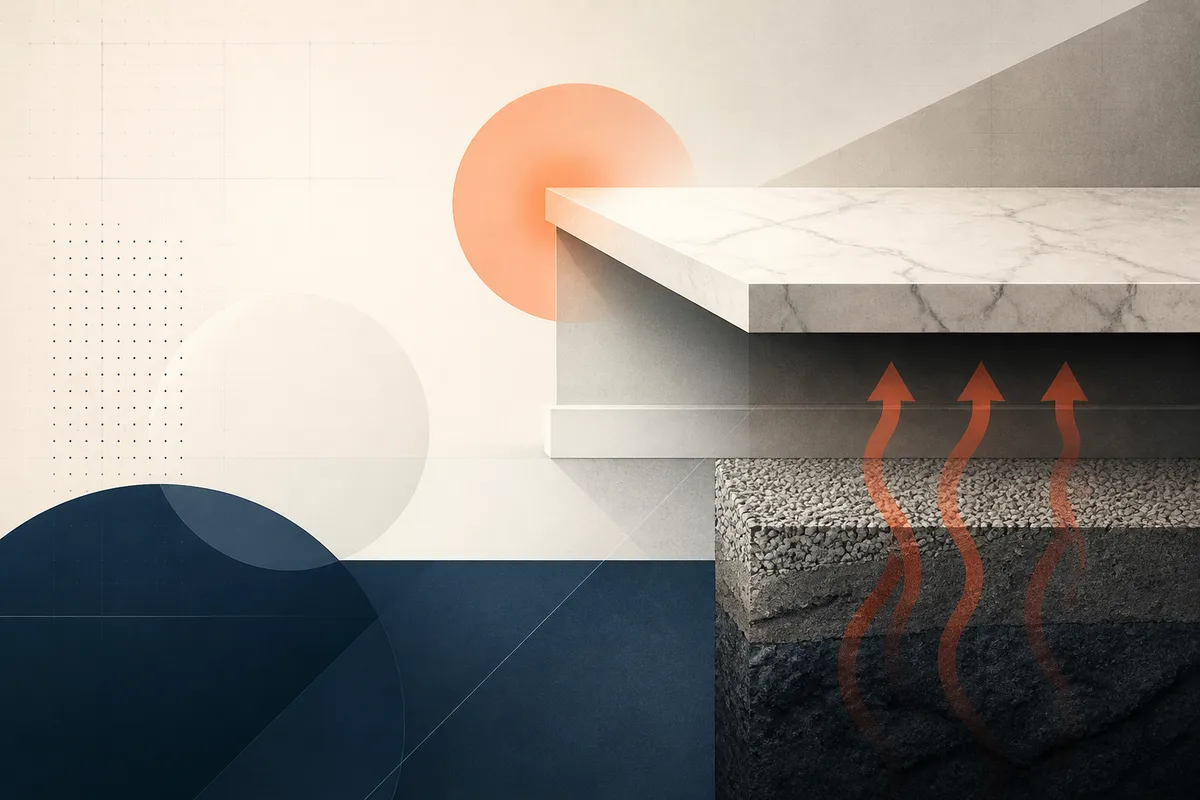
The Soil Infiltration Reality: Why Granite Countertops Are Rarely the Source of Indoor Radon
Homeowners often focus on visible finishes like granite countertops when investigating indoor air quality, fearing that luxury stone surfaces are "off-gassing" dangerous materials. In reality, the geological composition of the ground beneath a home is the primary driver of high readings, particularly in regions where the Utah Geological Survey notes that uranium—the precursor to radon—is a natural constituent of stone and soil.
This article clarifies the distinction between radon from granite countertops vs soil, providing a framework for identifying the source of contamination. For real estate professionals and residents in the Salt Lake City Service Area, distinguishing between these two sources is the difference between a successful mitigation and a failed investment.
Why Focusing on Granite Usually Fails to Lower Radon Levels
Focusing on building materials rather than the foundation leads to ineffective remediation because the volume of gas produced by stone slabs is mathematically small compared to the earth's surface area. The EPA estimates that radon from soil underneath a house contributes 95% or more of all indoor radon. As such, while any granite in a home may contribute some small amount of gas, the EPA states it is extremely unlikely that the stone alone would increase levels above the action limit.
- Air exchange rates in most modern homes dilute the small amount of gas emitted by countertops before it can accumulate.
- The concentration of radium in granite varies significantly between slabs, making it an inconsistent and unreliable predictor of total indoor risk.
- Soil gas enters a home under pressure, whereas granite emanation is a passive process that lacks the volume to compete with sub-slab infiltration.
- Foundation cracks, sump pits, and utility penetrations provide direct high-volume conduits for soil gas that granite surfaces cannot replicate.
The Comparative Framework: Emanation vs. Infiltration
To address indoor air quality effectively, one must distinguish between how these two sources behave within the building envelope.
1Identify the Entry Mechanism
Radon from soil enters via pressure differentials; the house acts like a vacuum, drawing gas in through the foundation. Conversely, radon from granite occurs through emanation, where the gas molecules escape the porous surface of the stone into the immediate surrounding air. According to research published on PubMed, significant within-slab variability exists, but these emissions are rarely the primary driver of a home's total radon profile.
2Measure the Concentration Gradient
Soil-based radon is almost always most concentrated in the basement or the lowest level of the home where the structure contacts the earth. If a test shows high levels in the basement but significantly lower levels in the kitchen where the granite is located, the soil is the culprit. A professional Radon Testing protocol will prioritize these lower levels to capture the maximum potential exposure.
3Conduct Differential Testing
If levels remain high after a standard mitigation system is installed, a technician may use a specialized "sniffing" device or charcoal canisters placed directly on the countertop. This helps determine if the stone is contributing a measurable fraction to the total load. However, this is an advanced diagnostic step that follows, rather than precedes, foundation-based testing.
4Execute Targeted Mitigation
Standard mitigation involves installing a vent pipe and fan to pull gas from beneath the slab and exhaust it above the roofline. If granite were the sole source—which is statistically rare—mitigation would instead require increased ventilation or, in extreme cases, removal of the material. Addressing the soil first is the industry-standard approach because it targets the source responsible for the vast majority of cases.
The measurement of how much radon gas escapes from the surface of a solid material, such as a granite slab, over a specific period.
How Radon Services Salt Lake City Helps
Managing indoor air quality requires a systematic approach to diagnostic testing and system design. For properties in the Salt Lake City area, a standard engagement begins with a high-sensitivity test to establish a baseline. If initial results are elevated, a professional inspection identifies the most likely entry points, such as unsealed sump pits or expansion joints. In cases where a home has already been mitigated but levels remain stubbornly high, radon retesting can help determine if secondary sources like building materials or well water are contributing to the total. Residents can request a consultation or site visit by calling (385) 541-6540 or visiting the main website at https://radonservicessaltlakecity.com/.
Frequently asked questions
Is granite radon dangerous to my family?
While granite can contain radioactive elements, the EPA indicates that most granite countertops do not emit enough radon to be considered a significant health threat. The primary danger to residents remains the gas infiltrating from the soil through the foundation. If you are concerned, a professional can perform a localized test of the stone surface.
How do I know if my radon is coming from the ground or my counters?
The simplest indicator is the location of the highest readings; soil gas is most concentrated in the basement, while gas from countertops would be most concentrated in the kitchen. If a basement test is low but a kitchen test is high, the countertops may be the source. However, in almost all cases, the basement reading will be higher, pointing to the soil.
Can sealing my granite countertops stop radon?
Sealing granite for stain resistance is not a reliable method for stopping radon emanation. Radon gas molecules are small enough to pass through many common sealants or escape through the unsealed underside of the slab. If a slab is truly problematic, ventilation or removal are the only recognized solutions.
Why is radon common in Salt Lake City homes?
The local geology in the Salt Lake City area contains higher concentrations of uranium in the soil and mountain runoff. As this uranium decays, it turns into radon gas, which easily moves through the porous valley soils and into home foundations. This makes geographical location a much higher risk factor than your choice of interior finishes.
Should I test for radon before buying a home with granite?
Yes, but the focus should be on the overall air quality of the home rather than the granite specifically. A standard real estate radon test will measure the total concentration in the lowest livable area. This accounts for all sources—soil, water, and building materials—giving you a complete picture of the home's safety.
What happens when you get in touch: you describe the situation, we ask the few questions that actually change the answer, and you get a clear scope and next step — no obligation.