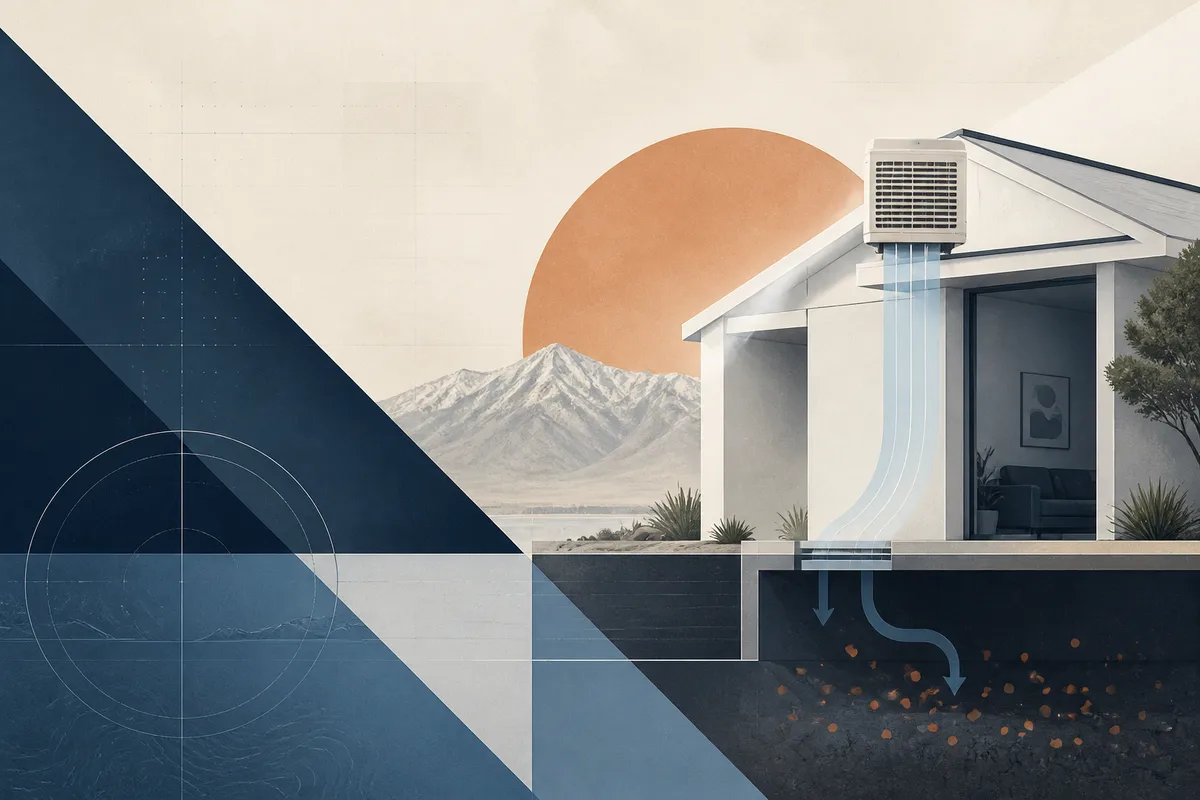
The Pressure Differential: How Swamp Coolers Suppress Radon Levels in Utah Homes
Homeowners in the Salt Lake City metro area often notice their indoor air quality feels different when they switch from central furnace operations to evaporative cooling. While most focus on the humidity shift, the more significant change is mechanical: an evaporative cooler acts as a high-volume ventilation system that forces outdoor air into the structure. This creates a positive pressure environment that physically pushes back against the vacuum effect usually responsible for pulling radon gas through foundation cracks.
This article examines the physics of pressure-driven soil gas entry and why homeowners in dry climates must account for cooling equipment when evaluating long-term health risks. Understanding the difference between dilution and mitigation is essential for anyone managing a property in a high-radon region.
Why Seasonal Cooling Masks Radon Risks
Most residential radon entry is driven by the "stack effect," where warm air rising and escaping through the roof creates a vacuum in the lower levels. Evaporative coolers reverse this dynamic by blowing massive quantities of air into the home.
- Positive pressure creates a physical barrier that prevents soil gas from being drawn into the basement or crawl space.
- High air exchange rates dilute existing indoor pollutants with outdoor air, as ventilation is increased due to the air being constantly cycled through the cooler.
- The requirement to keep windows partially open for the cooler to function facilitates a constant exhaust path for any gas that does enter.
- Passive soil gas entry is most aggressive when the home is sealed, making summer data an unreliable indicator of year-round safety.
Managing Indoor Air Pressure and Soil Gas
Effectively managing air quality in a climate where evaporative coolers work best requires a specific operational sequence to ensure safety data is accurate.
1Establish a Baseline During Closed-House Conditions
To understand the true risk, testing should occur when the home is not under positive pressure. In many regions, this involves testing during periods when the home is sealed and cooling systems are not active. If a real estate transaction requires a summer test, professional protocols often suggest the cooler be turned off and the home sealed for a period prior to and throughout the duration of the radon testing period.
2Recognize the Airflow Mechanism
Evaporative coolers function by passing outdoor air over a water-saturated pad, which cools the air through evaporation before the cooled air is blown indoors. Unlike traditional air conditioning, which condenses water out of the air and lowers indoor relative humidity, this process is an "open" system. The constant influx of air is why summer radon levels may appear lower, even in homes that might exceed safety thresholds in the winter.
3Evaluate Long-Term Exposure vs. Seasonal Dips
While the cooler is running, indoor exposure may be lower, but radon is a long-term health risk based on cumulative exposure. A low result in July does not guarantee safety in January. Local geology often drives indoor levels significantly higher once the swamp cooler is turned off for the season and the building envelope is closed.
4Monitor Indoor Humidity Effects
While radon levels might drop, evaporative coolers significantly increase indoor relative humidity. High humidity can impact the performance of certain passive charcoal radon test kits. Using continuous electronic monitors or professional-grade ion chambers provides more reliable data in these variable environments.
The Physics of Soil Gas Suppression
The effectiveness of a swamp cooler at lowering radon is not a result of "cleaning" the air, but rather changing the home’s relationship with the earth. By flooding the interior with air, the home becomes a high-pressure zone relative to the soil. Since gases move from high pressure to low pressure, the radon stays trapped in the soil beneath the slab. However, this is a temporary mechanical fix. Once the fan stops, the pressure equalizes, and the stack effect immediately resumes drawing gas through the floor. For consistent protection, especially in commercial & multi-family radon settings, a dedicated sub-slab depressurization system is often required to provide protection that doesn't depend on the cooling season.
How Radon Services Salt Lake City helps
Addressing radon in a home with evaporative cooling requires a nuanced testing schedule and a robust mitigation design. A standard project typically starts with a site assessment to identify foundation types and potential entry points. A technician will then design a sub-slab or crawl space suction system that operates independently of the HVAC equipment. This ensures that whether the windows are open in the summer or sealed tight in the winter, the pressure beneath the slab remains lower than the pressure inside the living space, keeping soil gas out of the home permanently.
More detail on the work itself: Salt Lake City Service Area.
Frequently asked questions
Will running my swamp cooler lower my radon test results?
Yes, running an evaporative cooler will typically lower test results by creating positive pressure and high dilution rates. This often leads to a result that does not reflect actual risk during the winter months. For the most accurate assessment of a home's safety, tests should be conducted under closed-house conditions.
Is a swamp cooler better than central AC for indoor air quality?
It depends on the pollutant. While swamp coolers can lower radon through ventilation, they can increase indoor humidity and bacterial endotoxin or microbial exposures if not maintained. Central AC lowers humidity but recirculates air, which can allow radon levels to climb if there is no active mitigation system in place.
Can I rely on open windows to stay safe from radon?
Opening windows provides temporary dilution, but it is not a permanent solution for radon gas. Because local radon levels can be significantly elevated, a permanent mitigation system is the only way to ensure safety without relying on the weather or seasonal cooling habits.
Should I test for radon in my home during the summer or winter?
Winter is often the preferred time for testing because homes are sealed, and the heating system creates a vacuum effect that pulls in more radon. If testing must occur in the summer, professional standards generally require the evaporative cooler to be off and windows closed to simulate the highest potential exposure levels.
Does the moisture from a swamp cooler affect radon mitigation systems?
The moisture from the cooler generally stays in the air and does not interfere with a sub-slab depressurization system. Mitigation systems are designed to handle moisture and condensation within their own piping, venting it safely above the roofline regardless of the indoor humidity levels.
What happens when you get in touch: you describe the situation, we ask the few questions that actually change the answer, and you get a clear scope and next step — no obligation.