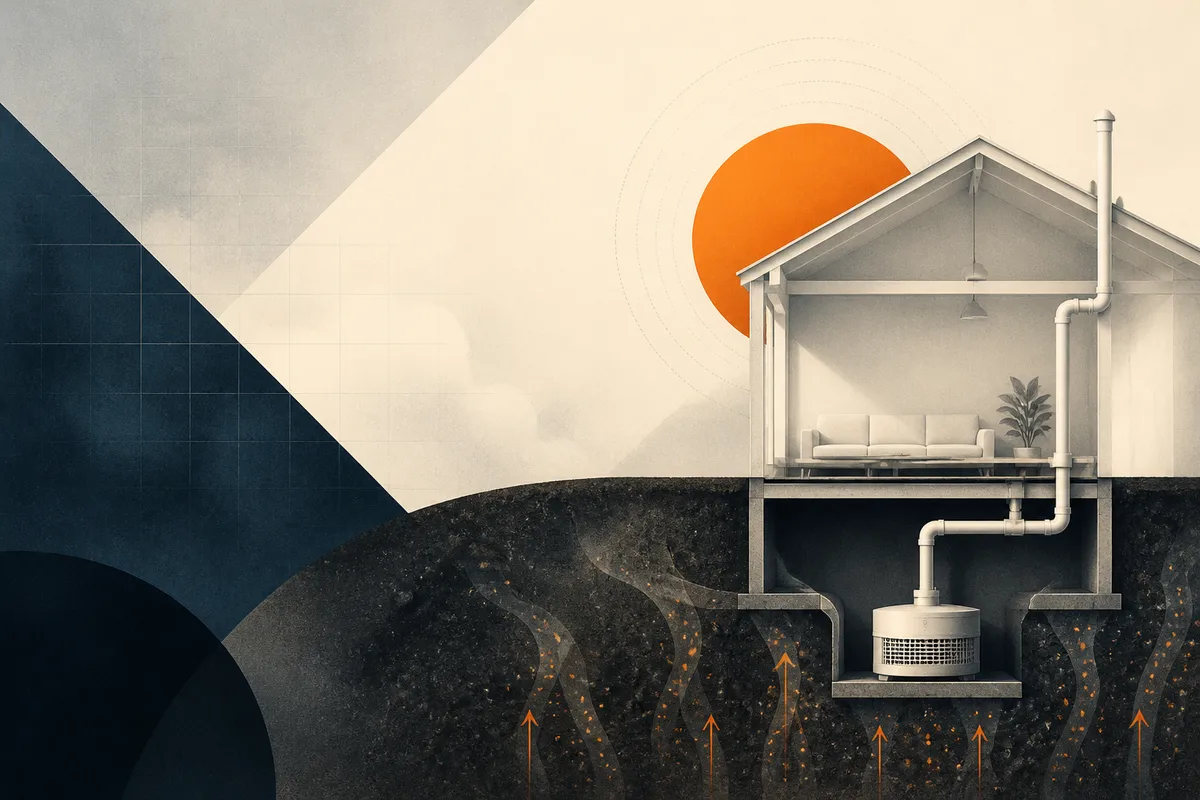
The Mechanical Reality of Soil Gas: Why Mitigation Systems Require Constant Operation
Homeowners often view a radon fan as they would a bathroom vent or a ceiling fan—an appliance to be toggled based on perceived need or to save on utilities. In the Salt Lake City metro area, where temperature inversions and soil compositions contribute to fluctuating indoor gas levels, this manual intervention is a fundamental mistake. A mitigation system does not simply "clean" the air; it physically alters the pressure dynamics of the home to prevent gas entry in the first place.
This guide breaks down the physics of sub-slab depressurization and explains why "should i run my radon fan all the time" is answered with a definitive yes. Whether you are managing a single-family home in Draper or a commercial property in Sandy, understanding the mechanics of soil gas migration is essential for maintaining a safe indoor environment.
Why Intermittent Mitigation Fails
Turning off a radon fan, even for a few hours, resets the environment to its natural, hazardous state. The vacuum created under the foundation disappears almost instantly, allowing concentrated soil gases to seek the lower pressure of the home's interior.
- The "Stack Effect" in Utah homes pulls soil gas upward through foundation cracks as warm air rises, a process that continues unabated if the fan is off.
- Soil gas concentrations under a slab can reach high levels, and without active suction, these gases permeate the floor via diffusion and advection.
- Once the pressure field collapses, re-establishing the vacuum and flushing out the accumulated indoor gas can take several hours or even days.
- Moisture that is normally exhausted by the fan can condense inside the PVC piping when the airflow stops, potentially dripping back into the motor housing.
The Framework for Continuous Soil Gas Management
1Maintain the pressure differential
A radon system works by making the area beneath the house a lower pressure zone than the house itself. If the fan is running, the gas follows the path of least resistance through the pipes and out the roof. If the fan stops, the house becomes the path of least resistance.
2Protect the mechanical components
Radon fans are specifically engineered for high-duty cycles. The bearings and motors are designed to run at a constant temperature; the cooling provided by the airflow itself is part of the design. Turning the system off and on causes the internal components to expand and contract, which leads to premature mechanical failure.
3Account for re-entry of soil gas after system shutdown
When a system is deactivated, the surge of gas into the home is often higher than the baseline level because the gas has been allowed to concentrate directly under the slab. This spike means that even if the fan is on for twelve hours a day, the average indoor levels may still exceed safety thresholds due to the intensity of the "off" periods.
4Evaluate radon system electricity usage
Modern fans are remarkably efficient, often drawing less power than a standard LED light bulb. The financial "savings" achieved by using a timer are typically measured in pennies per month, which does not justify the risk of increased radiation exposure or the cost of replacing a burnt-out motor.
The Dynamics of Sub-Slab Equilibrium
The effectiveness of a system depends on a stable equilibrium. In the Salt Lake City area, soil types vary from heavy clays to porous gravels, and each requires a specific vacuum pressure to remain effective. When the fan runs continuously, it creates a stable "bubble" of low pressure.
For properties with specialized needs, such as crawlspace radon mitigation, the volume of air being managed is different, but the principle remains the same. If the suction stops, the plastic membranes or sealed floors cannot prevent gas bypass. Furthermore, Utah’s radon techniques for new home construction emphasize that even passive systems are often upgraded to active ones precisely because constant mechanical draw is the most reliable way to overcome the natural pressure changes caused by Utah's varied climate.
The measurement of how effectively a vacuum reaches the furthest corners of a foundation, ensuring no dead zones where gas can accumulate.
How Radon Services Salt Lake City helps
Maintaining a mitigation system involves more than just keeping the power on; it requires periodic verification that the system is performing to its original specifications. A standard service engagement usually begins with a visual inspection of the fan and the U-tube manometer, followed by radon testing to ensure the indoor levels remain low. When a system is found to be failing or if a homeowner has been running it intermittently, the scope of work focuses on re-sealing slab penetrations and verifying that the fan motor hasn't been damaged by moisture buildup. For residents throughout the Salt Lake City service area, a professional evaluation can confirm that the system is sized correctly for the home's specific footprint and soil conditions.
Frequently asked questions
Should I run my radon fan all the time?
Yes, the fan must run 24 hours a day, 365 days a year. The system is designed to provide constant depressurization to prevent gas from entering the home. Stopping the fan allows gas to accumulate immediately, compromising the safety of the indoor environment.
Will turning off my radon fan at night save significant money?
The electricity usage of a standard radon fan is very low, typically comparable to a 40-watt to 60-watt light bulb. The cost savings from turning it off at night are negligible, usually amounting to less than the price of a single cup of coffee over an entire month.
Does a radon fan lifespan decrease with continuous run?
Counterintuitively, these fans last longer when they are left running. Constant operation keeps the motor at a stable temperature and prevents moisture from condensing inside the unit. Frequent starting and stopping is the most common cause of premature motor failure.
How long does it take for radon to return after turning off the fan?
Radon levels can begin to rise within minutes of a system shutdown. Depending on the soil concentration and the home's ventilation, levels can return to their pre-mitigation highs in as little as a few hours, necessitating a long recovery period once the fan is turned back on.
What should I do if my fan makes a loud noise or stops?
If the fan becomes noisy or the fluid in the U-tube manometer is level (indicating no vacuum), the system requires professional repair. In Salt Lake County, residents can call (385) 541-6540 to discuss repair options or visit the site to request an inspection of the system's mechanical integrity.
What happens when you get in touch: you describe the situation, we ask the few questions that actually change the answer, and you get a clear scope and next step — no obligation.