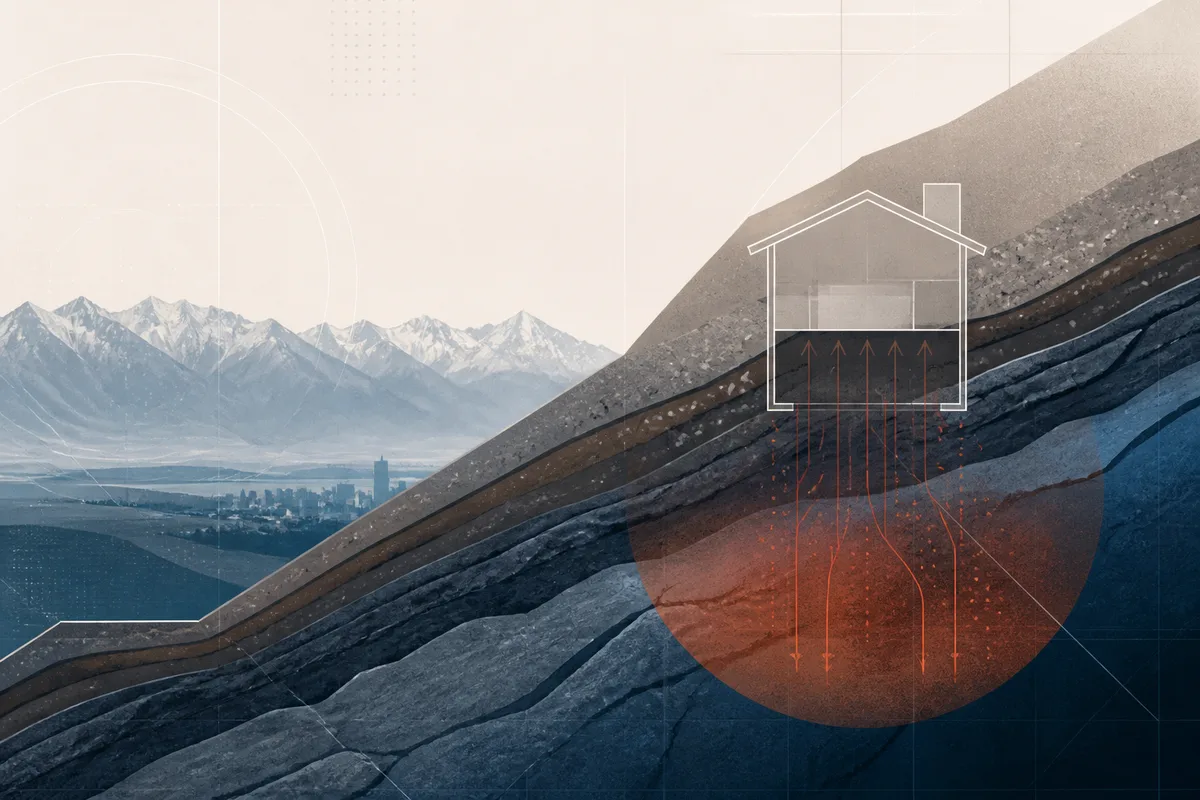
The Geology of Exposure: Why the Wasatch Front Traps Radon
Homeowners along the Wasatch Front often assume that new construction or tight building envelopes protect them from soil-borne contaminants. In reality, the geological history of the region—specifically the way the mountains were formed and how Lake Bonneville receded—creates a high-efficiency delivery system for radon gas. Because radon is colorless and odorless, the risk remains invisible until specific diagnostic testing is performed.
This guide breaks down the relationship between local lithology and indoor air quality. It is designed for real estate professionals and property owners who need to understand why the Salt Lake City Service Area is geologically predisposed to high gas concentrations.
Why Standard Radon Assumptions Fail in Utah
General national statistics often fail to capture the severity of the risk in the Intermountain West. The regional threat is not a matter of building materials, but a matter of the earth beneath the slab.
- High-purity uranium deposits in the Wasatch Range provide a near-infinite source of radium, which decays into radon gas.
- The high permeability of the "East Bench" gravels allows gas to travel much further distances from its source compared to clay-heavy soils.
- Temperature differences between a home's interior and the exterior environment create a "stack effect," which generates a pressure differential that draws soil gas into the structure.
- Granular lake sediments act as a subterranean highway, distributing gas horizontally across neighborhoods.
The Playbook for Understanding Local Radon Levels
To manage environmental risk in the Salt Lake City metro area, one must look at the soil profile and the mechanical interaction between the earth and the structure.
1Identify Source Rock Composition
The mountains surrounding the valley contain granitic and metamorphic rocks with elevated uranium content. As these rocks weather and erode, they wash down into the valley, depositing uranium-bearing rock directly into the soil layers where homes are built. According to Riverton City, radon comes from the natural radioactive breakdown of uranium in soil, rock, and water.
2Analyze Soil Permeability and Lake Sediments
During the era of Lake Bonneville, different layers of sediment were deposited; the shorelines left behind coarse gravels while the deeper areas left silts and clays. The Utah Geological Survey notes that radon is a radioactive gas that has no smell, taste, or color, and its migration is facilitated by the specific soil types in the region. A home built on an ancient shoreline is often at higher risk than one built on valley-floor clay.
3Evaluate the Pressure Differential
Homes act like large vacuums. As warm air rises and escapes through the roof, it creates a vacuum in the basement or crawl space that draws in air from the surrounding soil. In Utah, where temperature swings are dramatic, this pressure difference is often strong enough to pull radon through microscopic cracks in a concrete slab.
4Factor in Local Risk Distribution
Geological factors contribute to significant variability in gas levels. In some areas, like West Valley and Provo, over 50% of homes may be affected by high radon levels. This demonstrates that radon levels in Utah homes can vary significantly even between two houses on the same street.
The Lake Bonneville Legacy
The specific danger in the Salt Lake City region is the "Bonneville Effect." When the prehistoric lake drained, it left behind a complex subterranean map of high-flow gravel channels. These channels are frequently obscured by topsoil or landscaping but remain active conduits for gas.
The standard measurement of radon gas concentrations in air, where the EPA recommends mitigation for any home at or above 4.0 pCi/L.
Because radon levels are dictated by these deep geological veins, a neighbor’s low test result is never a guarantee of safety for the house next door. The subsurface pathways are too irregular for broad generalizations.
How Radon Services Salt Lake City Helps
Addressing elevated gas levels requires a transition from geological theory to mechanical intervention. A standard scope of work begins with professional Radon Testing to establish a 48-hour baseline of the home's air quality. If levels exceed the 4.0 pCi/L threshold, the typical response involves sub-slab depressurization—a method that uses a dedicated vent pipe and fan to intercept soil gas before it enters the living space. Property owners should ensure that any mitigation strategy includes sealing sump pits and floor cracks to maximize the system's efficiency against the local soil pressure. For inquiries regarding testing or system design, property owners can reach the office at (385) 541-6540 or submit a request through the website.
Frequently asked questions
Is radon only a problem for homes with basements?
No, radon can accumulate in homes built on slabs or over crawl spaces. While basements have more surface area in contact with the soil, the pressure differential of the home can pull gas through a slab-on-grade foundation just as effectively. Crawl space homes often see high levels because the exposed earth provides a direct path for gas to enter the floor joists.
Why does my neighbor have low radon levels while mine are high?
Radon levels are highly localized due to the "finger-like" distribution of gravel and silt deposits from Lake Bonneville. One home may be sitting on a pocket of permeable gravel that acts as a gas conduit, while the neighbor is on a dense clay lens that blocks gas movement. Only individual testing can confirm the status of a specific property.
Can I just seal the cracks in my basement to stop the radon?
Sealing cracks is a necessary component of a larger strategy, but it is rarely effective as a standalone solution. Radon gas is under pressure and can permeate through the pores of concrete or through the small gap between the floor and the wall. A mechanical system is usually required to create a permanent low-pressure zone under the house.
Does the age of my home affect the radon risk?
Newer homes are not inherently safer; in fact, they are often built more tightly, which can trap radon gas inside more effectively than older, draftier homes. Furthermore, modern construction often involves significant soil disturbance, which can open up new pathways for gas to migrate toward the foundation.
How often should I retest my home for radon?
Health authorities such as the Huntsman Cancer Institute suggest testing every two years, or after any significant structural changes or seismic activity. Shifting soil and new cracks in the foundation can change the way radon enters a building over time.
Does the time of year affect my test results?
Radon levels are typically higher in the winter. This is due to the "stack effect," where the temperature difference between the warm interior and cold exterior creates a stronger vacuum, and the fact that windows and doors remain closed, preventing natural ventilation. Testing during the heating season often represents the "worst-case scenario" for exposure.
What happens when you get in touch: you describe the situation, we ask the few questions that actually change the answer, and you get a clear scope and next step — no obligation.