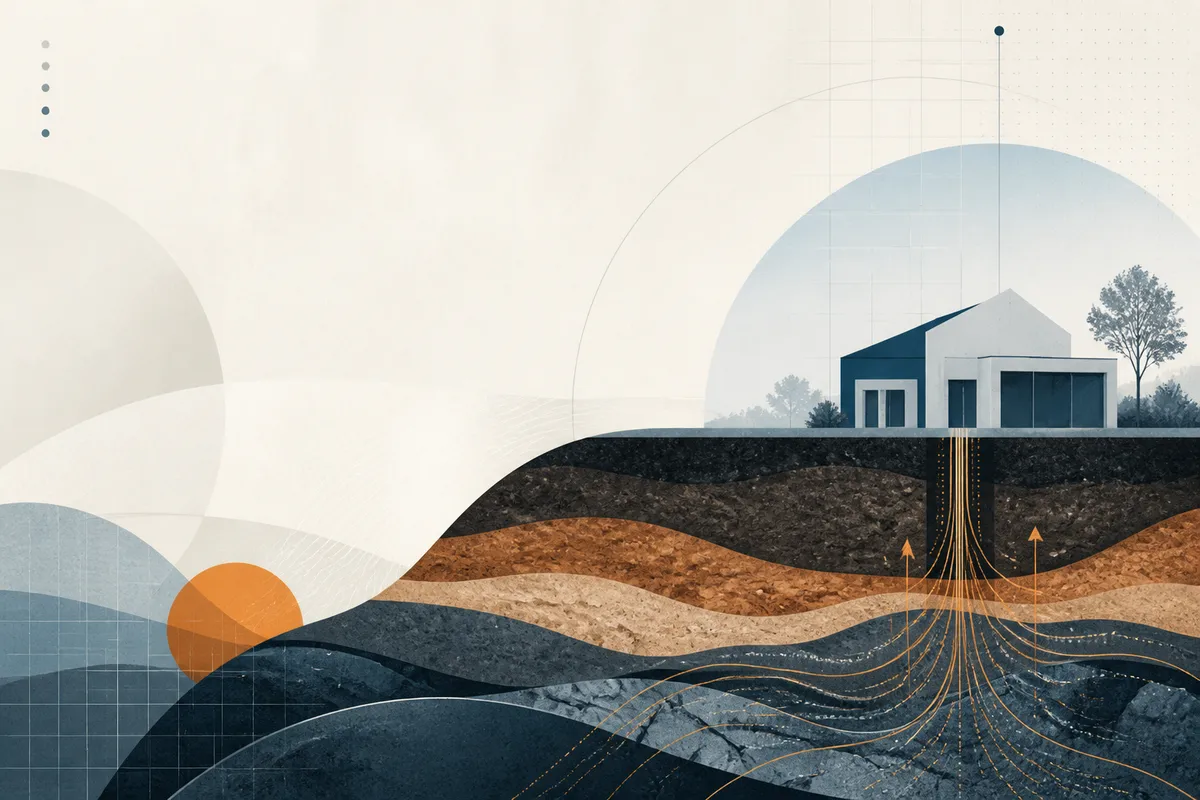
Soil Permeability and Radon Levels: The Impact of Local Geology on Gas Migration
Homeowners in the Salt Lake City area often find it baffling when a neighbor’s house tests low for radon while their own home registers well above the EPA action level. The discrepancy rarely stems from the age of the home or the quality of construction; instead, it is driven by the specific lithology beneath the foundation. In the transition from porous mountain bench gravels to the dense, silty sediments of the valley floor, the physics of gas migration changes entirely, dictating how easily radon reaches a basement.
This guide explains the relationship between soil permeability and radon levels and how local geology influences the mechanical requirements of a mitigation system. Whether you are managing a real estate transaction or assessing your own home, understanding the "path of least resistance" in the soil is the first step toward a permanent solution.
Why Geologic Variance Overrides Building Age
Modern building codes have improved moisture barriers, but they cannot fully stop the vacuum effect created by a home’s thermal stack. The geology of the site determines the volume of gas available for the home to "inhale" through the slab.
- Highly permeable soils, such as the alluvial gravels found near the mountains, allow radon to migrate long distances before it decays.
- Dense, impermeable soils containing clay-rich layers naturally inhibit the flow of soil gas, often resulting in lower entry rates even if radon is present in the ground.
- Soil moisture acts as a temporary barrier, as radon travels shorter distances in wet soils than in dry soils before it decays.
- Human-made alterations, such as the imported structural fill used under suburban slabs, can create a high-permeability "micro-climate" regardless of the native soil.
The Playbook for Assessing Soil Gas Risks
Mitigation is not a one-size-fits-all installation; it is a pressure management problem that requires an understanding of the local substrate.
1Identify the Primary Soil Classification
Before installing a system, a technician must account for the local geological makeup. The USGS notes that highly permeable soils and bedrock are significant risk factors because they do not "trap" the gas, allowing it to move freely toward the low-pressure zone of a basement. In the Salt Lake City metro area, the difference between a gravel bench and a silty flat can be less than a mile.
2Establish Baseline Radon Concentrations
A standard Radon Testing protocol is necessary to determine the current indoor concentration. While the EPA estimates that one in every 15 homes nationwide has an elevated level, local concentrations are highly sensitive to the lithologies found in the study area, which vary based on the mineral content of the soil.
3Map Sub-Slab Communication
In dense silt or clay, a single suction point may not be enough to pull air from the far corners of the house. This is known as poor "communication." If the soil is tight, the system needs a higher-static pressure fan to overcome the resistance of the dirt; in porous gravel, a high-airflow fan is often used to move a larger volume of gas at lower pressure.
4Address Foundation Transitions
Many homes in the region feature a mix of full basements and crawl spaces. These different foundation types interact with the soil differently. For homes with dirt floors, crawl space radon mitigation involves using soil gas membranes to create an artificial "slab" that allows for suction in areas where the soil would otherwise be too loose to manage.
The Lake Sediment vs. Bench Gravel Dynamic
The geological history of the region created a distinct divide in how soil gas behaves. The eastern benches consist largely of coarse, well-sorted gravels deposited by ancient shorelines. These soils have high void spaces, meaning air moves through them with almost zero resistance. In these areas, a radon system can often clear an entire footprint with a single suction pit because the "reach" of the vacuum is extensive.
Conversely, the western portions of the valley often contain clay-rich layers that inhibit the flow of soil gas. While this sounds like a benefit, it can create "hot spots" where gas is trapped under a slab and forced through small cracks at high concentrations. This requires a more strategic approach to suction point placement to ensure no pockets of gas are left unaddressed.
How Radon Services Salt Lake City Helps
Navigating the complexities of local geology requires a technical approach to sub-slab depressurization. A standard scope of work for this region involves a site evaluation to determine foundation type, followed by diagnostic testing to see how well air moves under the specific soil conditions of the property. For properties in the service area, this often includes sealing sump pits and floor cracks to prevent the system from "stealing" air from the house rather than the ground. Homeowners can reach a specialist to discuss their specific neighborhood risks by calling (385) 541-6540 or requesting a consultation online.
Frequently asked questions
Does a "clay" soil mean I am safe from radon?
Not necessarily. While clay is less permeable, it can still harbor high concentrations of radon gas. If the soil dries out and cracks, or if the house was built on a layer of porous structural fill over the clay, the radon can still migrate into the living space quite easily.
Why did my neighbor's house test at 2.0 pCi/L while mine is at 12.0 pCi/L?
Radon levels are extremely variable and depend on the amount of radioactive material in the bedrock directly beneath the home, as well as soil moisture and permeability. Minor shifts in the underground soil layers or the presence of a "utility trench" filled with gravel can create a direct highway for gas into one home but not the one next door.
How does soil moisture in Salt Lake City affect my test results?
Radon transport in soils occurs via diffusion and flow. According to EPA documentation, soil permeability to gas flow can increase during drier periods. During heavy rain or snowmelt, the water fills the void spaces in the soil, potentially capping the gas and forcing it to find an exit through the dry soil underneath your foundation.
Can I install a radon system myself if I have sandy soil?
While sandy soil is easier to move air through, radon mitigation requires specific pressure field extension testing to ensure the system is actually protecting the entire footprint. Improperly installed DIY systems can backdraft water heaters or fail to reach the necessary suction levels, leaving the home at risk despite the fan running.
What is the difference between a high-flow and high-suction fan?
The choice depends entirely on your soil. High-flow fans are used for porous gravel where you need to move a lot of air. High-suction (high-static pressure) fans are used for tight soils like silt or clay, where the fan has to work harder to "tug" the air through the dense material.
What happens when you get in touch: you describe the situation, we ask the few questions that actually change the answer, and you get a clear scope and next step — no obligation.