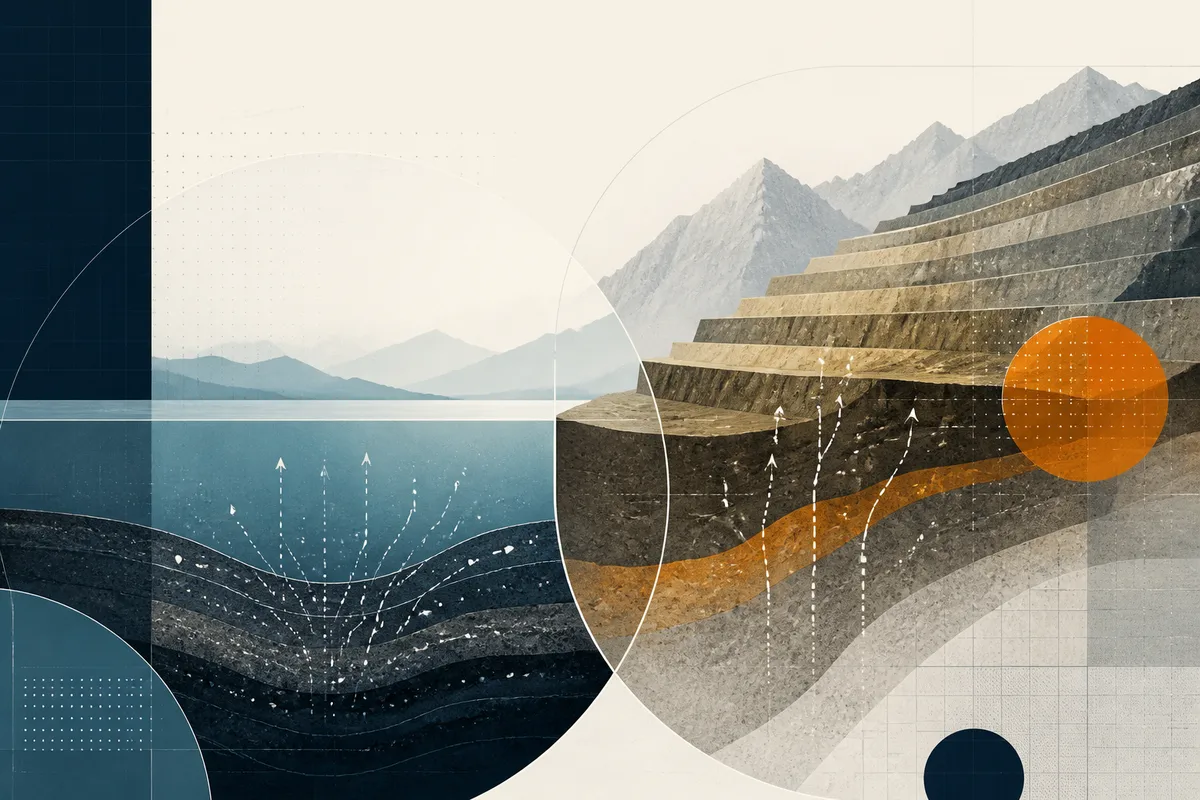
Soil Gas Dynamics in Lakebed Sediments vs Mountain Benches
Homeowners in the Salt Lake City basin often assume that a dry basement is a safe basement, but soil gas behavior is dictated more by geology than by moisture. In dense, fine-grained sediments, gases like methane and radon do not move freely; they can accumulate under pressure until they find a structural bypass. Conversely, porous gravels allow for rapid gas movement, meaning a house on a hill may face different infiltration risks than a property in the valley center.
Understanding the distinction between radon vs methane soil gas is critical for property managers and residents. While radon is a byproduct of uranium decay in the soil, methane is produced from the decay of organic matter (BuildingGreen). This guide breaks down how soil permeability dictates gas hazards and why a "one-size-fits-all" mitigation strategy fails in complex geological environments.
Why Geologic Variation Dictates Gas Risk
Building on the "benches" versus the "flats" involves more than just a change in elevation; it involves a fundamental shift in how the earth breathes. When soil gas cannot vent naturally through the surface, it follows the path of least resistance—usually the porous backfill around a residential foundation.
- Fine-grained clay and silt sediments act as a cap, trapping gases at higher pressures than sandy or gravel-heavy soils.
- The USGS notes that geologic conditions directly affect indoor radon gas concentrations, as radon has greater mobility than the solid matter in rocks and soils.
- High water tables in lowland areas can physically displace soil gases, pushing them upward into crawl spaces and basements during seasonal shifts.
- Variations in soil permeability can cause radon activity to range from 0.11 to over 400 kBq m−3, according to research on soil gas radon assessment.
The Playbook for Differential Soil Gas Mitigation
1Identify the Source and Sediment Type
Before installing any equipment, the specific geology of the site must be understood. Factors such as soil permeability dictate how gas moves through the subsurface and how easily it can be drawn from under a concrete slab. Properties in the lower valley deal with tight clays where standard vacuum pressure may meet higher resistance than in gravel-heavy soils.
2Differentiate Between Radon and Methane
Radon is a heavy, radioactive gas with no smell or color that originates from the natural decay of minerals in the soil. Methane is produced from the decay of organic matter (BuildingGreen) and refers to the confinement of gas within the interstitial pore spaces of subsurface soils (Geo Forward). Because radon is a gas, it has much greater mobility than its parent elements, radium and uranium.
3Assess Sub-Slab Permeability
The success of a mitigation system depends on "pressure field extension," or how far a vacuum can reach under the floor. In highly permeable soils, one suction point may cover a large area. In heavy clays, technical adjustments to the number of suction points or fan specifications may be necessary to overcome soil resistance and ensure adequate air flow from beneath the foundation.
4Seal Infiltration Pathways
Gas enters through cracks in the slab, sump pits, and utility penetrations. In areas with high soil gas pressure, simply installing a fan is insufficient. A thorough scope of work includes the mechanical sealing of the slab and the installation of airtight covers on sump basins to ensure the mitigation system pulls from the soil, not the conditioned air inside the home.
The Mechanism of Pressure and Density
The interplay between gas density and soil porosity creates specific subsurface conditions. Methane, being lighter than air, tends to rise quickly and can accumulate in pockets under a foundation. Radon, being significantly heavier, often settles in low-lying areas like basements and sumps.
When these gases are trapped under dense clay, they can create a pressurized reservoir. When a home’s HVAC system creates a slight vacuum—often referred to as the "stack effect"—it effectively draws these gases through microscopic cracks in the concrete. A professional Radon Testing protocol accounts for these variables by measuring levels during closed-house conditions when these pressure differentials are most pronounced.
How Radon Services Salt Lake City Helps
Managing underground gas hazards requires a detailed understanding of local soil mechanics. A standard engagement begins with diagnostic testing to determine the concentration and entry points of soil gases. For properties in the Salt Lake City area, this involves evaluating the impact of soil permeability and sediment types on gas migration. A sound scope of work typically includes the installation of a sub-slab depressurization system, sealing of the foundation, and post-mitigation verification to ensure the pressure field is effectively diverting gases away from the living space. Professional evaluations are available through the Radon Services page or by calling (385) 541-6540.
More detail on the work itself: Salt Lake City Service Area.
Frequently asked questions
Can a home have both radon and methane issues?
Yes, particularly in areas where uranium-bearing minerals in the soil overlap with deposits containing organic matter. While radon is common, methane can be present in specific pockets where organic decay occurs, requiring a mitigation system designed to handle the specific properties and volumes of both gases.
Does clay soil protect a home from radon?
No, clay does not act as a complete barrier. While clay is less permeable than sand, it often develops desiccation cracks or allows gas to move through the disturbed soil around a house foundation. When gas does penetrate clay, it can do so at higher pressures, which may lead to concentrated infiltration points.
How does the water table affect soil gas?
A rising water table can displace the air in soil pores and force soil gases upward toward a home's foundation. During wet seasons or heavy runoff, indoor gas levels may fluctuate as moisture occupies the subsurface spaces where gases previously resided, shifting the gas toward the path of least resistance.
Is methane testing included in standard radon inspections?
Standard radon testing focuses specifically on alpha particle emissions from radon decay and does not detect methane. If a property is located in an area where methane is a known concern due to organic decomposition, specific combustible gas indicators must be used to screen for methane separately.
How long does a soil gas mitigation system last?
Sub-slab depressurization systems are designed for long-term operation. The centrifugal fans are built for continuous use, and the passive elements of the system, including the PVC piping and slab seals, are designed to remain effective for the life of the building as long as the foundation remains intact and seals are not disturbed.
Do I need to retest if I live in a high-permeability area?
Yes, because high-permeability soils allow radon to move more easily and over longer distances from its source (USGS). Homes in these areas should be tested regularly, as the porous nature of the soil provides a clear pathway for gas to reach and enter the foundation.
What happens when you get in touch: you describe the situation, we ask the few questions that actually change the answer, and you get a clear scope and next step — no obligation.